Undoubtedly, one of the about significant advancements in calculating in the by two decades or and so has been virtualization. Virtualization has unlocked the true potential of modern hardware platforms. Information technology has allowed a paradigm shift in the data eye for organizations that can now run much denser, more efficient environments than ever before.
Many different hypervisors and solutions are available, including "pay for" enterprise datacenter hypervisor solutions to freely bachelor desktop and server virtualization products that allow taking advantage of the efficiencies and capabilities provided by virtualization. Microsoft's Windows 10 operating system is arguably 1 of the most pop OS'es subject field to virtualized solutions. In this guide, we will wait at the best virtual machine for Windows x and encounter what platforms are available to virtualize Microsoft's most popular Os.
What is Virtualization?
Equally mentioned, virtualization has been a revolutionary technology that allows organizations to use physical server hardware in ways that were not possible before. With traditional servers and workstations, you have one operating organisation spring to i set of physical hardware. In traditional data centers, this means you have one copy of the Windows Server operating arrangement or Linux operating system installed on the underlying concrete hardware.
The traditional way of installing operating systems on concrete hardware is very limiting. Information technology highlights many challenges with the conventional approach to operating systems installed on a single physical hardware set up. For one, your operating arrangement and any services, resources, and other critical information residing on it are subject area to any hardware failures and other issues with the underlying concrete hardware.
Virtualization allows effectively abstracting this traditional one-to-i human relationship so that many operating system "instances" can run on peak of the aforementioned set of physical hardware simultaneously. The operating arrangement instances run in what are known as virtual machines. This layer of brainchild at present means that multiple virtualized hosts tin run in a clustered way and then that an operating system is resilient to a particular virtualization host failure. The operating arrangement instance can move to a different host if a virtualization host fails. What makes these capabilities possible?
Hypervisor
The many capabilities and abstractions provided by virtualization are made possible by using a hypervisor. A hypervisor is a software chosen a virtual machine monitor that creates and runs virtual machines. The hypervisor separates and isolates the hypervisor, operating system, and all the physical resources. The hypervisor serves as an abstraction layer between the operating organisation and the underlying physical hardware.
The hypervisor aggregates concrete hardware resources, such as CPU, memory, and storage, into resources pools. It allows effectively providing resources for many different virtual machines on the aforementioned set of concrete hardware. Hypervisors include the following components:
- Process scheduler
- Memory manager
- I/O stack for input/output operations
- Device drivers
- Security layer
- Network stack
The hypervisor uses the above components and others not listed to provide resource to virtual machines. You may wonder how a hypervisor can provide resources such as compute cycles to many different virtual machines using the same hardware. This capability is possible through the hypervisor's scheduling of physical resources such as the CPU. You can call up of the hypervisor as the manager of the CPU's time that schedules out the processing of requests coming from the various virtual machines. The hypervisor scheduler can schedule time with the CPU so that all requests from the different virtual machines are processed efficiently.
Type ane vs. Type 2 hypervisor
When choosing the best virtual machine for Windows x or any other virtual machine, it ways you will select between either a Type one or Type 2 hypervisor. What is the difference? Each one has different characteristics to note. To brainstorm with, let'due south take a look at the Type 1 hypervisor.
A Blazon ane hypervisor is also known every bit a bare-metallic hypervisor. It is a bare-metal hypervisor because the hypervisor software is installed direct on top of the physical server hardware. Since the Type 1 hypervisor has no software or other operating system between it and the underlying concrete hardware, it can reach fantabulous performance. The hypervisor itself to exist the operating system. Since the hypervisor is the operating organization installed on the physical hardware, information technology is not intended for any other purpose other than running virtual machines. The Type 1 hypervisor is the primary type of hypervisor used to run virtual machine workloads in the enterprise information eye.
Blazon 2 hypervisors run on top of the operating organisation of the physical host machine. For this reason, they are known as hosted hypervisors. It means that Type 2 hypervisors have a layer of software betwixt them and the underlying concrete hardware. The software layer is the host operating organisation such equally Windows 10, Windows Server, or Linux operating arrangement.
Blazon 2 hypervisors' operation is not equally good equally Type 1 hypervisors since there is a software layer between it and the physical hardware. Nevertheless, Type 2 hypervisors can simply be used as an application installed on the host operating system. It means the hypervisor does not monopolize the utility of the physical host. You can use the host for other purposes than running virtual machines.
The best virtual automobile for Windows ten
Every bit we have already covered, the hypervisor plays a crucial role in virtualization engineering science's capabilities and functionality. There are many different hypervisor solutions on the marketplace today, some paid products and others that are free. In this guide comparing the diverse features of different hypervisors bachelor, we will consider the best virtual machine for Windows 10 and other VM workloads yous may accept. Permit'southward await at the post-obit available hypervisors:
- Virtualbox
- VMware Workstation Pro and Workstation Player
- VMware ESXi
- Microsoft Hyper-V
- VMware Fusion Pro and Fusion Player
How does each of the available hypervisors compare and contrast in terms of price, features, compatibility, and other aspects?
Virtualbox
VirtualBox is an extremely well-known x86 and AMD64/Intel64 virtualization solution widely used from the enterprise data middle to the home user and enthusiast alike. It is a Type 2 hypervisor that runs beyond a broad range of platforms, including:
- Windows
- Linux
- macOS
- Solaris
It too supports many guest operating systems that range from legacy Os'es to the latest versions of Windows, Linux, Solaris, OpenSolaris, Bone/2, and OpenBSD. It makes it an excellent platform for playing around with, testing, learning, and running workloads for various use cases. For those keenly interested in Windows virtualization, VirtualBox provides i of the healthiest arrays of different Windows OS'es available for virtualizing, including legacy Windows operating systems back to Windows 3.one.
Virtualizing Windows x with Oracle VirtualBox
In particular, VirtualBox runs Windows 10 very well and provides many dissimilar settings and features that allow a seamless and pleasant experience with the Windows ten Os across its various flavors. One of VirtualBox's "features" that stands out is it is an open-source program that is free. You pay no license fees or any other fees to use and run the software. Some may be a bit concerned about VirtualBox's open-source nature regarding back up and whatever issues that may arise. Nevertheless, VirtualBox has a salubrious post-obit and is a community-supported product with support from VirtualBox gurus on the forums.
VirtualBox is easy to run and requires very picayune to no previous experience with other hypervisors to get up and running with Windows 10 in a VM. The software interface is intuitive and easy and features a very "point and click" oriented arroyo to running your VMs. However, while you tin can certainly have the defaults with the plan, it features many extra "nerd knobs" you can tweak to your liking with your VMs.
One of the features that may especially appeal to Windows 10 virtualization for some users is a new feature called seamless mode. With the seamless mode functionality of VirtualBox, yous can brandish windows institute in a virtual auto side by side next to the windows shown in your host. After the seamless fashion functionality is enabled, VirtualBox suppresses the display of your guest's desktop background. It makes the windows appear seamlessly adjacent to host windows, which provides the feel of the window from the guest operating system residing natively on the host.
VirtualBox provides a robust set of network management features that allow customizing networking and connectivity as needed while using VirtualBox. VirtualBox certainly does not disappoint with the networking features made possible with the VirtualBox Host Network Director. Using the Host Network Director, you can create new virtual networks configured manually or automatically. Y'all can likewise configure your host networks with DHCP capabilities for guest IP configuration running on a detail host network segment.
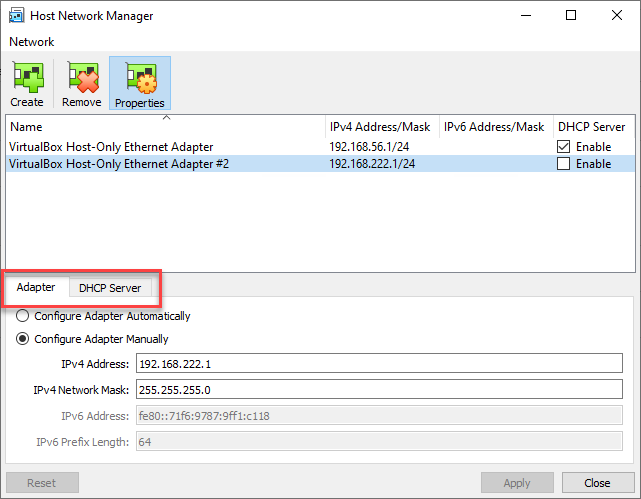
VirtualBox Host Network Manager
Below, we enable the DHCP server on a new Host-only network segment configured using the Host Network Manager in VirtualBox. You can configure the DHCP server IP address ranges assigned to guests.
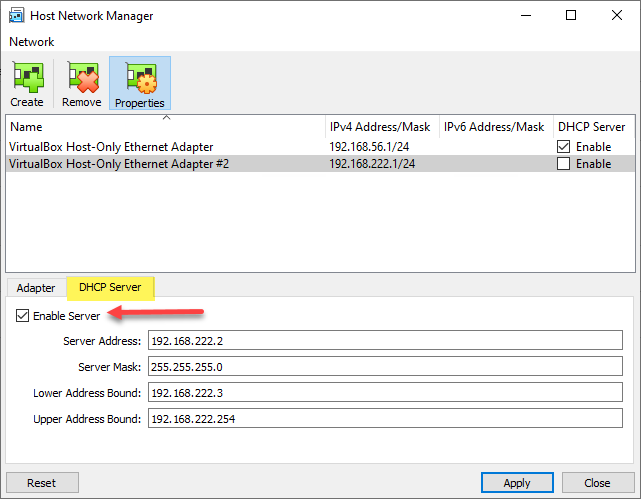
Configuring the Host Network Manager DHCP server
The flexibility offered past VirtualBox allows configuring your Windows x VMs and others for various types of connectivity apply cases, exam scenarios, lab environments, etc. Information technology is nice to see that VirtualBox provides a robust feature set in the surface area of networking. Networking support is arguably one of the most important functional features and capabilities to look for with a hypervisor.
What almost nested virtualization? Nested virtualization allows you lot to run a hypervisor within another hypervisor. Why is this important? Suppose you want to utilize Hyper-V inside a Windows 10 test VM that you take running within a hypervisor such every bit VirtualBox. Having the ability to employ nested virtualization means you can test and use Hyper-V installed on your Windows ten virtual automobile running inside VirtualBox. VirtualBox supports this by enabling nested virtualization at the VM level.
Nested virtualization allows exposing the concrete processor's virtualization settings on your virtualization host to an underlying virtual car. With VirtualBox, you can enable nested virtualization using either the GUI or the control-line.
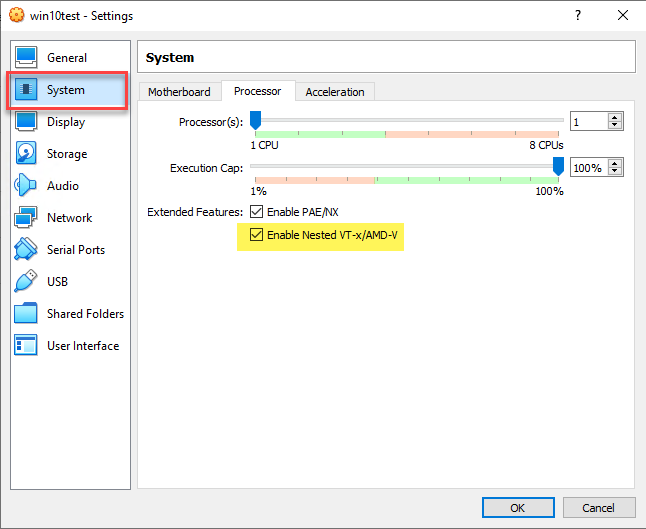
Enabling nested virtualization on a Windows x VM running in VirtualBox
From the command-line in VirtualBox, y'all can enable nested virtualization using the following commands:
- Vboxmanage.exe list vms
- Vboxmanage.exe modifyvm "<your VM>" –nested-hw-virt on
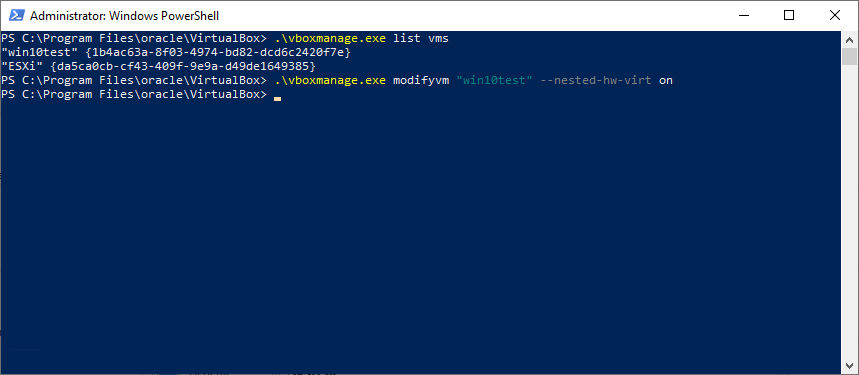
Using the VirtualBox control-line to enable nested virtualization
Another point to mention with VirtualBox is Oracle has provided several pre-built VirtualBox VMs readily available for download. For the most part, the VMs cater to developers who want quick access to programmer VMs running Oracle. These are Linux boxes that come preinstalled with programmer tools to interact with Oracle and other solutions.
VMware Workstation Pro and Workstation Role player
VMware Workstation has long been a standard in desktop virtualization in the enterprise and for power users. It is a Type ii hypervisor that provides the "Cadillac" of features that offer users robust capabilities to run Windows 10 virtual machines and many other types of workloads, including containers. What features does VMware Workstation provide?
VMware Workstation Pro provides an first-class desktop virtualization platform
- Ability to run VMs, containers, and Kubernetes clusters on a single workstation
- Work with a wide range of operating systems and technologies
- It offers a robust set of nested virtualization features
- Interact with and even manage VMware vSphere environments
- Provide secure, isolated environments for development, testing, and other use cases
VMs, Containers, and Kubernetes
With VMware Workstation, you can run multiple virtual machines, OCI containers, and Kubernetes clusters on the aforementioned Windows or Linux host running VMware Workstation. You can create fully segmented and isolated networks with network condition simulation. The platform provides a "Swiss Ground forces knife" solution that is an excellent choice for developers, solutions architects, application testing, and demonstrating product functionality.
Piece of work with a wide range of operating systems and technologies
VMware Workstation provides the ability to work with a wide range of operating systems, including the Windows 10 operating system's latest versions. You can also work with OCI containers and Kubernetes clusters using kind and Minikube.
Robust fix of nested virtualization features
VMware Workstation is known for its abilities in the realm of nested virtualization. You can easily configure and provision an unabridged lab containing Windows 10 workstations, Hyper-V, and nested virtual machines running on Windows 10 with the Hyper-Five role installed.
Interact with and manage VMware vSphere environments
One of the corking features you lot become with VMware Workstation is interacting with and managing VMware vSphere environments. If you have an existing enterprise VMware vSphere environment, y'all can use your VMware Workstation GUI dashboard to add together and manage vSphere. It includes configuring, powering on and down virtual machines in vSphere, and creating and managing locally housed Windows 10 and other VMs in VMware Workstation.
Secure, isolated environments
Many choose to apply VMware Workstation running on their Windows ten host to run a Windows ten VM used for another purpose such equally a browsing VM, development, cybersecurity forensics, network management, etc. With the snapshot and other features provided by VMware Workstation, information technology allows quickly rolling your Windows 10 VM back to a known good state at any point.
VMware Workstation provides a robust feature set that connects your virtual machines to fit your environment needs from a networking perspective. By default, VMware Workstation creates the following networks in the Virtual Network Editor. These include a bridged network, Host-only, and NAT. Equally with VirtualBox, y'all can tweak the DHCP Settings.
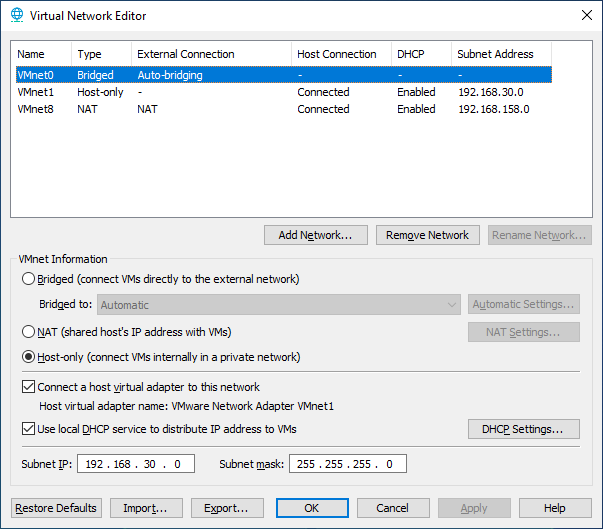
Virtual Network Editor with VMware Workstation
Later on clicking the DHCP Settings button, yous can configure the DHCP Settings with all the expected settings, including starting and catastrophe address and lease fourth dimension settings.
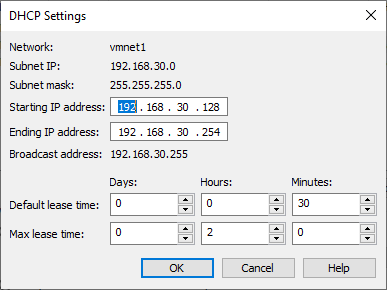
Customizing the virtual network DHCP settings in VMware Workstation
A really interesting ability that VMware Workstation provides is the power for network condition simulation that allows simulating network conditions, including latency, package loss, and even the bandwidth of your connection. The network condition simulation is a convenient tool to have access to for troubleshooting, development, and other purposes.
Having the ability in your Windows 10 development workstation or other VM to simulate network conditions is a great tool to let development applications or testing processes and services over very slow links or other adverse network conditions. The network condition simulation is a feature not found in VirtualBox. Notwithstanding, VMware Workstation is a pay-for product. You can install and apply VMware Workstation for 30-days in a trial period.
As mentioned earlier, nested virtualization is something that VMware Workstation does uncommonly well. Many in the community house their entire virtualization domicile lab off VMware Workstation running on either a workstation-form machine or a powerful laptop. It means you tin set up your entire virtualization lab featuring nested hypervisors such as ESXi running child VMs with Windows customer operating systems similar Windows 10.
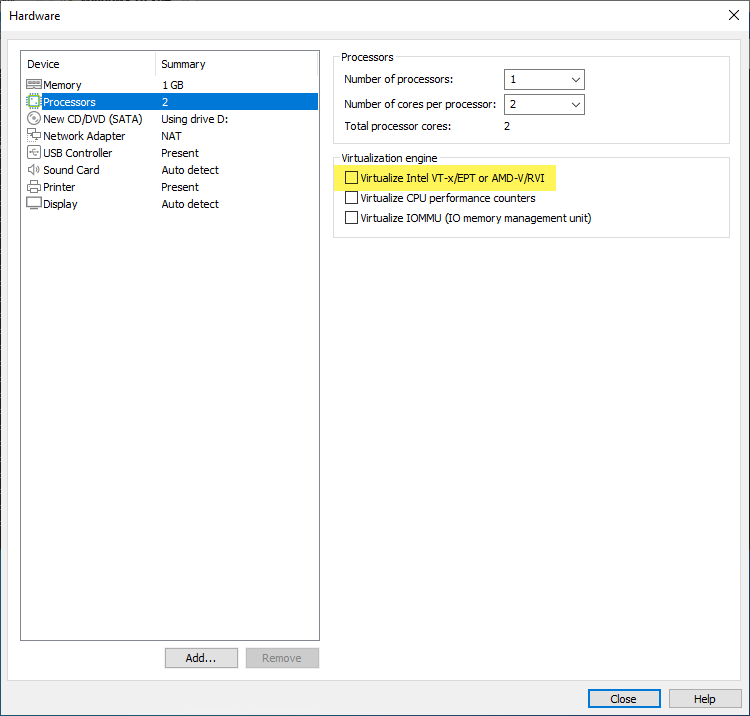
Configuring hardware virtualization in VMware Workstation for nested virtualization
VMware Workstation Thespian is a free version of VMware's desktop virtualization platform that provides the ability to take both a graphical and command-line interface for running a single VM. It is meant for use cases where a unmarried VM is needed to create a secure, isolated sandbox on a PC. It is usually used in educational activity environments as a free and easy way to learn more than about Information technology and computer systems in full general.
VMware ESXi
VMware's enterprise hypervisor is arguably the most well-known hypervisor in the enterprise environment today. VMware has a long history in the world of virtualization. They pioneered the virtualization movement back in the early on 2000s and have revolutionized the virtualization industry always since. In its current form, the ESXi hypervisor represents many years in development and touts some of the well-nigh cutting-edge features compared to any other hypervisor bachelor on the market.
VMware ESXi is a Type 1, bare-metal hypervisor that provides a consummate set of features and capabilities needed in enterprise data centers. It is both a free production from VMware and a licensed software solution purchased with support and additional licensed features nosotros will embrace below.
Specifically, VMware markets the VMware ESXi free edition as vSphere Hypervisor. Yous tin easily download the vSphere Hypervisor past signing upward for a VMware account (gratis) and requesting the ESXi free hypervisor. If yous have a dedicated concrete host that yous plan on using for virtualization learning, practise, running Windows 10, and other guest VMs in a dedicated fashion, this is a bang-up pick.
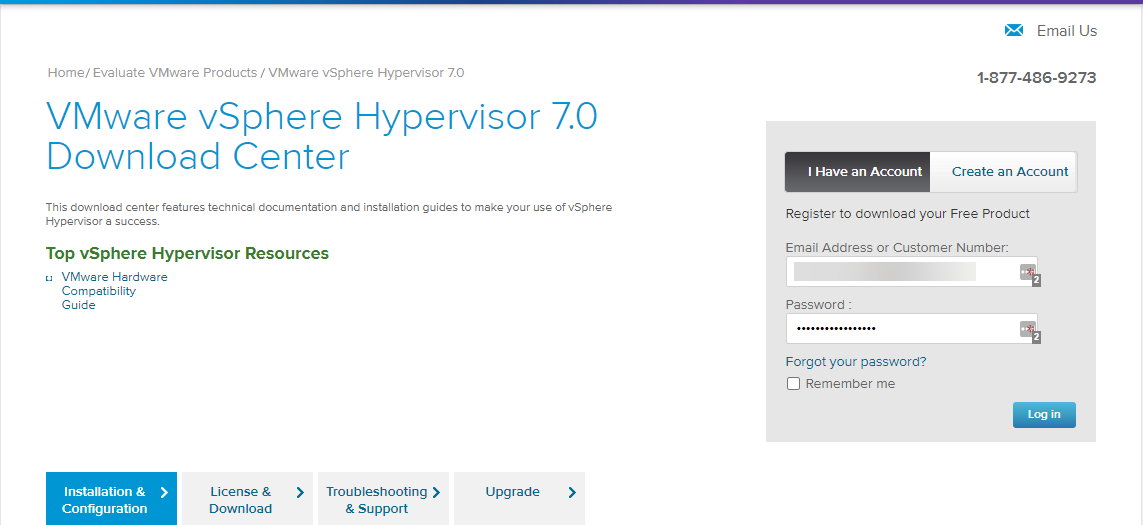
Downloading VMware vSphere Hypervisor 7.0
VMware touts the vSphere ESXi hypervisor as the "earth'due south smallest and almost robust compages." In that location are a few limitations to note with VMware ESXi free. The restrictions for the gratis vSphere Hypervisor include the post-obit:
- Virtual Machine vCPUs are limited to 8 vCPUs
- No VMware Support
- No vSphere Storage APIs are exposed
- No direction using vCenter Server
The complimentary version of ESXi volition function essentially equally a defended workstation or laptop that would run your Windows 10 or other virtual machines. Keep in mind that fifty-fifty though this is a Type 1 bare-metallic hypervisor, you will non be able to practise any fancy high-availability or resource scheduling between multiple nodes. These enterprise features require a vCenter Server in the mix. Even so, if you are looking at the list of hypervisors to employ for the best virtual auto for Windows ten, VMware ESXi is arguably the "foam of the crop" amid hypervisors out in that location.
Now, as mentioned, there are limitations with the free version of the ESXi hypervisor. However, if you want to take all of the enterprise features and capabilities for your Windows ten and other workloads, you can pace upwardly to the paid version of VMware ESXi. With the latest licensed version of VMware vSphere ESXi 7.0 Update 1, you tin can now create virtual machines with a whopping 24 TB of retentiveness and 768 vCPUs. What other enterprise features practise y'all get with the paid version of vSphere ESXi?
- VMware High Availability (HA)
- VMware Distributed Resource Scheduler (DRS)
VMware Loftier Availability (HA)
Let's say you lot have a Windows 10 VM that is production critical, and you desire to ensure information technology tin can withstand the failure of a hypervisor host. With the paid version of VMware ESXi and vCenter Server in the mix, you tin configure a vSphere cluster. The vSphere cluster ensures that you accept multiple hosts sharing a pool of resources. If a single host fails, VMware High Availability (HA) kicks in, and the virtual machine relocates to a healthy host remaining in the cluster.
Distributed Resource Scheduler (DRS)
DRS is a tremendously powerful feature found in the enterprise version of vSphere. With DRS, the resources in the vSphere cluster are automatically normalized across the bachelor cluster resources. With DRS'southward capabilities, virtual machines tin exist vMotioned beyond dissimilar hosts in the cluster depending on which host better satisfies the equation of a "happy VM" over the others.
In terms of networking capabilities, in both the gratuitous and paid version of ESXi, you go admission to the vSphere Standard Switch (VSS), which provides robust networking capabilities out of the box. VSS features include VLAN trunking, the ability to create isolated switches, failover behavior, some light security features, etc. Those who have the Enterprise Plus license of vSphere or a vSAN license have access to the vSphere Distributed Switch (vDS). The vDS switch provides the near powerful and fully-featured virtual switch capabilities. With the vDS, you tin automate and streamline your virtual networking configuration and centralize the management with the vCenter Server.
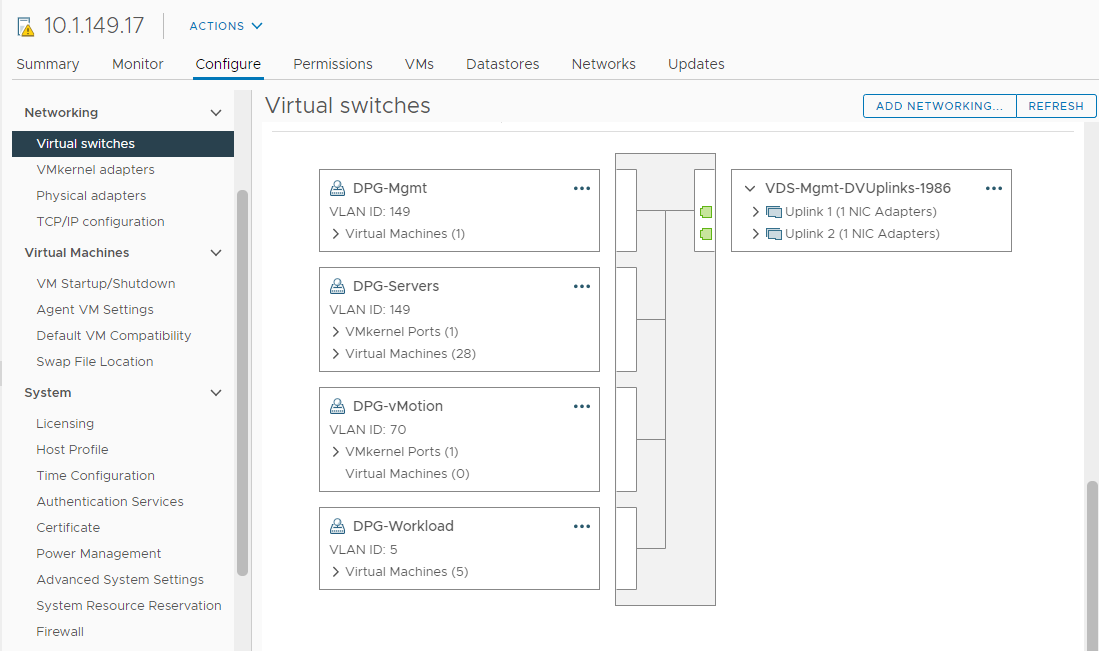
Viewing virtual networks configured for an ESXi host
VMware ESXi also provides the power to run virtual machines using nested virtualization. It allows the ability to run virtual machines that are hypervisors and run kid VMs running in the surround. Nested virtualization in ESXi is configured using the Hardware Virtualization – Expose hardware-assisted virtualization to the guest OS flag assail a per-VM basis on VMs running on top of ESXi. As a note, this setting is also bachelor and configurable with the costless version of ESXi.
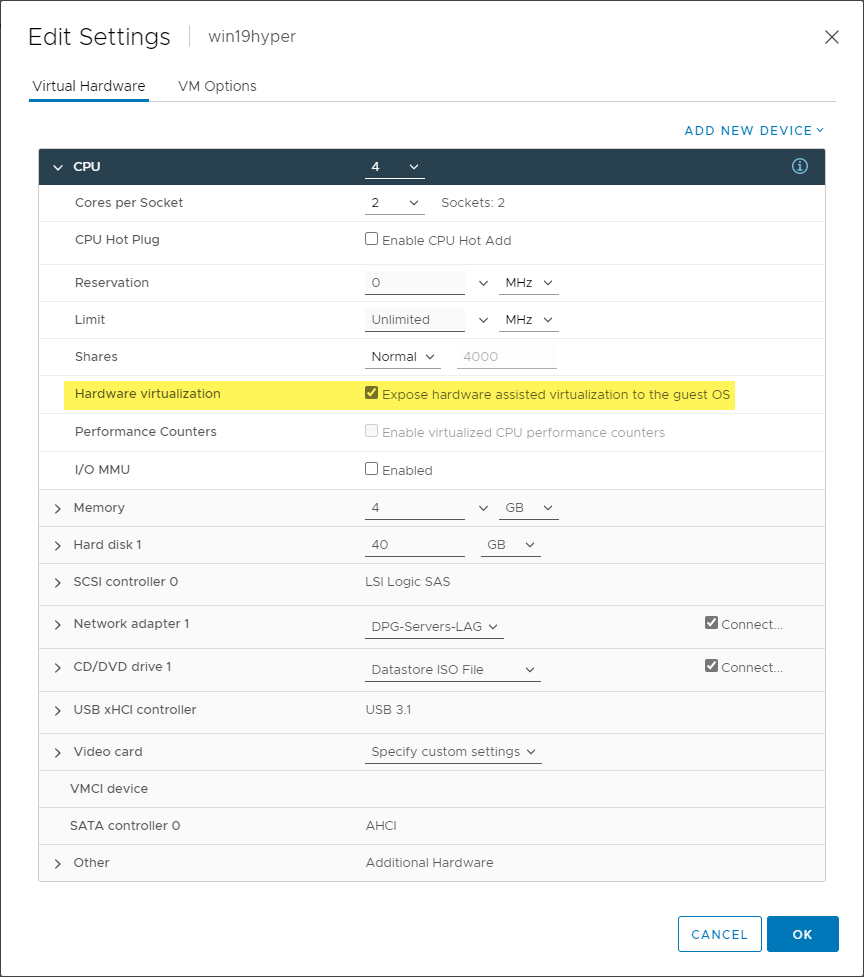
Configuring the hardware virtualization setting for nested virtualization
Any way you piece it, VMware ESXi is an excellent hypervisor with world-course features used to host millions of workloads across myriads of information centers, both public and private. In its gratuitous form, information technology is still powerful but has limits to note. Licensing for vSphere ESXi and vCenter Server is non cheap, then ESXi free may provide all the functionality and features needed.
Microsoft Hyper-V
Microsoft has been playing catchup with VMware over the by several years in enterprise virtualization. Over the past several years, they take been working hard to advance the Hyper-Five solution to incorporate the features and functionality that enterprise customers have longed for over the by several years. With the introduction of Windows Server 2019, Microsoft Hyper-5 has become a fully-featured enterprise-class hypervisor that is genuinely prepare for enterprise workloads.
Like VMware vSphere, Microsoft Hyper-5 comes in a free and paid version. Hyper-V Server is the free version of Microsoft Hyper-Five. Hyper-V Server, a Blazon one hypervisor, is a special-purpose operating arrangement from Microsoft that is essentially Windows Server Core with the Hyper-V Function installed by default. When y'all install Hyper-V Server, you can customize and configure the server through the sconfig utility, which provides a pseudo-GUI interface in text format that is bill of fare-driven for configuration. Afterward, you tin utilize Hyper-V Manager on a management workstation or Windows Admin Heart to manage the Hyper-V host.
With Hyper-V Server, at that place are limitations from the full-blown Windows Server installation with the Hyper-V Role added. For one, there are no licenses included with Hyper-V Server compared to Windows Server Standard with 2 VM instances and Windows Server Datacenter, unlimited VMs. Microsoft Hyper-V Server is a corking platform, especially for running Linux virtual machines. Withal, there are no limits to running Windows guest VMs other than licensing. Notwithstanding, it is noted this is a consideration with any hypervisor platform unless running Windows Server 2019 with the Hyper-V Role installed.
At that place is nevertheless another Hyper-V hypervisor to consider when you want to run Windows ten or other virtual machines. It is the Hyper-Five Windows feature for Windows 10.
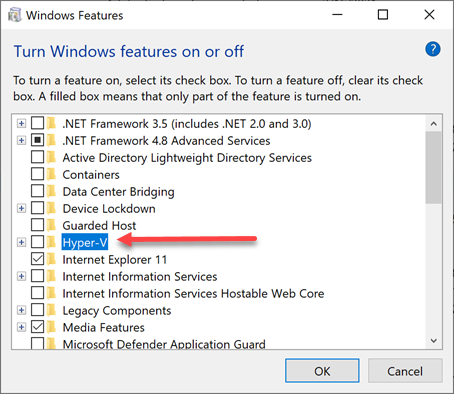
Hyper-V Windows feature for Windows 10
When y'all install the Hyper-5 Windows characteristic, this installs the Hyper-Five characteristic in Windows and instantiates the Hyper-V hypervisor earlier the Windows 10 operating organization. This process is how the Hyper-V Role is still considered a Type 1 hypervisor despite the appearance that information technology is running on top of the host operating organization.
Microsoft makes a few things easier with Hyper-Five on Windows 10, such every bit creating a default virtual switch for network connectivity, which is not the instance with Windows Server Hyper-Five. With Windows 10 Hyper-V, you become the "Quick Create" sorcerer that easily creates virtual machines. Retrieve of Windows 10 Hyper-5 functionally the same as VMware Workstation and VirtualBox.
VMware Fusion Pro and Fusion Player
The VMware Fusion Pro and Fusion Player products from VMware are the MacOS equivalent to VMware Workstation Pro and Workstation Player products for Windows and Linux and share the same basic features as mentioned above. It includes support for running VMs, containers, Kubernetes clusters, and interacting with VMware vSphere. With VMware Fusion Pro and Fusion Player, yous can run Windows 10 on top of macOS and even run additional copies of MacOS in your Mac environment. Here is more information about VMware Fusion Pro and Fusion Actor.
Best virtual machine for Windows 10 FAQ
Let's answer the following ordinarily asked questions related to running Windows x inside a virtual machine.
Is in that location a virtual machine for Windows x?
- Microsoft does provide VHDs for downloading Windows ten every bit a virtual motorcar for use with Hyper-V. These can be converted to other formats, such as the VMDK, for use with VMware. Otherwise, Windows 10 virtual machines are created in the hypervisor of your choosing using the downloaded ISO from Microsoft.
Which is the best virtual machine?
- The best virtual machine may be subjective for most users. Windows users volition take unlike needs than MacOS users, as an case. Others desire to use virtual machines as an application on their host, while others may want to accept a defended host running their virtual machine. It is difficult to crown a blazon of Windows 10 virtual machine as the best.
Is VirtualBox better than VMware?
- Both VirtualBox and VMware ESXi hypervisors provide great features. VirtualBox is a free Type 2 hypervisor that has long been used as a quick and easy virtualization platform providing a wide range of features and functionality. VMware ESXi free is a Type i bare-metal hypervisor that provides compelling features. All the same, to get the full enterprise data center virtualization features, yous will need to purchase a vSphere ESXi license as well equally a vCenter Server license. Once again, better is hard to quantify. VMware ESXi is arguably the well-nigh powerful hypervisor on the planet. However, many volition capeesh the ease with which VirtualBox can be installed, configured, and run virtual machines.
What is the best free VM software?
- VirtualBox takes the crown for the best free VM software. Based on the bachelor features, not bad networking, nested virtualization, and the ease of providing virtual machines, information technology stands out among other gratis hypervisor solutions for running Windows 10 and other virtual machines.
Concluding Thoughts
Choose the best virtual machine for Windows 10 depends on your needs and use case. It also relies on which operating system you want to utilise for the host. If you are looking to use virtualized Windows 10 instances from time to fourth dimension but practice not need VMs constantly running, the Type 2 hypervisors mentioned such equally VirtualBox, VMware Workstation, and VMware Fusion may be first-class choices. Windows 10 Hyper-V, which is a Type 1 hypervisor can likewise part in this style. However, if yous are looking to run VMs continuously, you will want to consider VMware vSphere ESXi or Microsoft Hyper-V for this purpose.
DOWNLOAD HERE
Posted by: bakernetur1949.blogspot.com
Post a Comment